I wonder if any internet entrepreneur has come up with a web service to help with choices in present buying… I’m envisaging a website called EitherOr which enables people to outline a number of gift options, and possibly a ‘none of the above’ option, for the individuals they want to buy for. The recipients would be notified and be able to use links to review the items and to choose the option they want. The service would then purchase the item for them and have it sent to them. The ‘none of the above’ option, if provided, might enable the recipients to specify any item on the net up to the specified amount, for the service to purchase for them.
Author Archives: admin
Nuggets about Nuggets across 38 years
To review what I’ve done on the topic of information nuggets, I’ve been trawling through the PAWDOC Index and files. The earliest example of sidelined text that I can find in my document collection was from October 1981 when I was working at the National Computing Centre. I can’t remember why I started to do it – but it may well have been prompted by the method that NCC’s Chief Editor, Geoff Simons, used to construct his books. He explained to me that he read everything about a subject, identified key points and put them on Post-it notes which he stuck on the wall. When he was ready to write, he rearranged the Post-its into separate sections and in sequence within the sections – and I saw examples of this in his office. At some point I started to employ this technique to construct the best practice books I wrote at NCC – but using the word processor on our new Zynar Office System to assemble and organise the key points. Sidelining text was an obvious way to identify key material to feed into that process.
Around 1994 I started talking with City University academics Clive Holtham and David Bawdon with a view to undertaking a joint project on ‘The Paperless Office Worker’. A key strand of this work would involve me digitising my PAWDOC collection. Extracts from emails between us in the early part of 1994 included the following:
Email from Clive Holtham: ‘….I don’t record each document as Paul does, but file at a quite detailed level. What I am conscious of is how much I forget about what I already have. The equivalent of underlining is important – we need to consider something more than keywords to store with each piece.’
Reply from Paul Wilson ‘…I agree with needing to deal with the underlining problem. I have sidebars on most of my material – they are the information nuggets; but I don’t know how much use they would be out of context.’
Email from Paul Wilson: ‘… with reports , papers etc. I usually mark the nuggets of info within them – presumably these are the bits of information I really want.’
The collaboration with City University proved very productive: Clive Holtham introduced me to a product Manager in Fujitsu who loaned me a scanner; and to the owner of a small company called DDS who loaned me the Paperclip document management software. Soon I was scanning my existing paper documents and new ones as they arrived. In January 1997 I issued my 3rd briefing note on these activities and included the following towards the end of the four page document:
Despite the close relationship between filing and information use, contemporary filing systems provide little other than title and index fields to support the knowledge acquisition, synthesis and use process. Filing systems, it seems, are there just to store items and to aid their retrieval. Unfortunately, the personal knowledge acquisition, synthesis and use process is not supported adequately outside filing systems either. Some standalone packages do exist, but they are not intended to be used in a day to day manner for personal knowledge acquired in documents, electronic files and other artefacts. In fact, even the need for such support is not widely recognised.
It is not yet clear to me what support could be most beneficial. However the clues are littered throughout the practices of knowledge workers like myself. For example, whenever I read articles, papers and reports I always mark the good bits – the nuggets of information. These are key points which I particularly want to augment the knowledge in my brain. Sometimes when I have been researching a topic I collect together all the nuggets I can find, categorise them and reorder them, and synthesise a new view of the topic in question. Unfortunately, like the magnesium nodules on the floors of the deep ocean, huge numbers of nuggets now litter my filing system unseen and inaccessible. I hope they are in my brain and that they have been used to develop my current state of thinking – but I’m not so sure that their huge potential has been fully exploited.
For my filing activities to really start adding value I need tools which can record those nuggets as I consume and index each item, and which can enable me to reorganise those nuggets, add more nuggets, and synthesise new nuggets, in the process of actively developing my ideas. Such tools would, of course, maintain the links to the original source material stored in my files. And my files would become a combination of original source material and the representations of my developing thoughts and ideas.
Now that I am confident that I have the paper scanning and electronic file indexing activities under reasonable control, it seems high time to start addressing the critical area of information use and its role in knowledge management.
These are the earliest mentions I can find of information nuggets in the PAWDOC collection – and they give no indication of where I picked up the concept from. In fact I can only find one published mention of the term and that was in the Lotus Notes-oriented magazine ‘Groupware and Communications Newsletter’ from April 1998 in which one Ted Howard-Jones gave a brief description of a service implemented by a major financial institution to capture competitive information. He wrote:
‘Called Report-It!, this service captures knowledge using a secure voice-mail system and delivers categorised information directly to the desktops of office-bound managers and competitive information professionals. These nuggets of professional information are disseminated via Notes.’
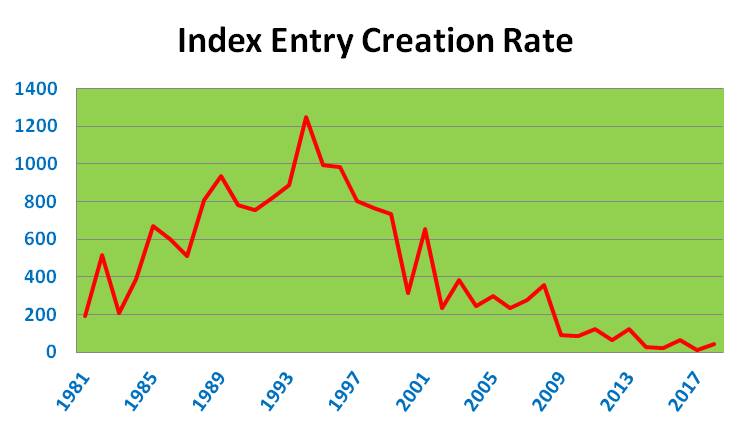
The use of the term Knowledge in this article, and in my briefing paper mentioned above, reflected the fact that, in the late 1980s, the term Knowledge Management started to became fashionable and by the late 1990s had become a holy grail of IT Professionals, Management Consultants, and Academics. The first mention of the term in the PAWDOC Index appears in 1990, and occurs in a further 137 Index entries from then to 2016. The company I worked for (Computer Sciences Corporation – CSC) was a global computer services organisation with tens of thousands of employees worldwide. Its involvement in the Knowledge Management topic came from three angles: first, its clients started to ask about it and how to do it; second, its consultants and salesmen saw it as a potential source of revenue; and third, its employees and management began to think that they needed it internally to improve the effectiveness of the business. Hence, as a consultant in the UK end of the business, I was aware of or got involved in:
- A number of initiatives to develop an offering or information for clients, including:
- the development of a KM service by CSC Netherlands in 1990;
- discussions with CSC UK Management Consultants who were developing KM propositions, in 1996-8;
- the definition and design of a KM service by CSC UK personnel to address opportunities in a number of clients including ICI Paints, LUCAS Engineering, John Menzies and United Distillers, in 1996-7;
- the publication a CSC Research Services Foundation report on KM in 1998;
- news of CSC’s Global Knowledge Management services, in 2001.
- The development of such systems for clients (primarily using web pages on intranets), including:
- a presentation to ICI Paints in 1992;
- the development of systems for KM and for a web-based ‘Gazateer’ of all KM, architecture and other organisational information, for the Nokia SCC – a new organisation being set up by CSC UK for Nokia, in 1997;
- the design and population of a web-based KM system for Dupont Agriculture’s architectural components, in 1998.
- the development and use of internal CSC solutions, including:
- attendance at internal CSC workshops on developing an organisational learning infrastructure in 1996;
- the development of an improvement process for CSC’s new application development organisation that was being designed and built from scratch, in 1998;
- the design of a practical KM programme for CSC UK’s reorganised Consulting & Systems Integration unit, in 1999;
- knowledge management work being done for BAE, in 1999;
- an internal Community of Interest on the subject of Personal Knowledge Management, in 2001.
Of course, my rather lowly personal filing perspective had to be rapidly expanded as I entered the Knowledge Management (KM) arena to accommodate both high level Management Consultancy notions of ‘Intellectual Capital’ and the distinction between Knowledge and Information; and the practical need to derive benefits from an investment in KM by effectively sharing the knowledge that had been acquired. Indeed, one of my contributions to the internal Community of Interest mentioned in the last bullet point above seems to herald a change in my thinking. My opening sentence reads:
‘Since collaborating with everyone in this shared space I’ve had my eyes opened to the concept that KM is all about enabling people to find things and work together, as opposed to the idea that KM is all about nailing down bits of knowledge and providing it to people. I realise that there is significant crossover between the two approaches – but nevertheless giving priority to one or the other will result in significantly different activities.’
During the 1990s I learnt a great deal about what people thought Knowledge Management was, and also about the powerful potential of the new web technology to support KM. However, throughout this period I don’t recall any specific conversations or documents about dealing with underlined, sidelined, or highlighted text. Indeed, by the time I completed the draft of the paper summarising my PAWDOC findings in June 2001, it seems that my ideas on the subject had advanced no further than that reported above. The paper was published in the journal Behaviour & Information Technology (BIT), and addressed the subject as follows in the section on ‘Areas of Investigation and Summary Findings’:
Q27. How can an electronic filing system be used to develop and use knowledge?
- Include substantive information in the index entries, for example phone numbers, book references, and expense claim amounts.
- Identify the nuggets of information (i.e. the valuable bits) when you first read a document
- Capture and structure the nuggets into the overall nugget-base at the same time as indexing the item
Status: ideas formed
Q28. What is the best way to capture and structure information nuggets?
Probably by using a Concept Development tool. Some initial prototyping has been done using the Visual Concepts package and the eMindMaps package.
Status: ideas formed
Q29. Is it feasible and practical to capture and structure information nuggets as well as indexing items?
Status: not started
Q30. Is it worthwhile building and developing an information nugget base?
Status: not started
The Concept Development prototyping mentioned in the answer to Q28 above probably started in April 2001 when I acquired a free copy of the eMindMaps software, and by the end of 2001 I had started making MindMaps of books on esoteric topics such as the Egyptian pyramids and the origin of Atlantis. I have no record of my detailed intentions in doing this, but I guess I wanted to experience the process of recording all the nuggets I found in a book – and then to explore what could be done to integrate and exploit the material from several different MindMaps. In all, I made MindMaps of 19 books over a two year period; but that’s as far as I got. At the end of 2001 I started a new job in bid management and my energies were increasingly taken up with managing very intensive bids, with documenting the bid process, and with operating a Lessons Learned programme. I had no time to pursue these information nugget ideas any further.
This concludes my review of my previous activities in the use of information nuggets. The questions I posed in the 2001 BIT paper still remain largely unanswered, and the operation of the PAWDOC system has not provided any further insights on the subject since then. However, the existence of the sidelined documents, and of the 19 MindMaps, do provide an opportunity to undertake some rudimentary practical work to explore if the information nuggets identified were memorable and of any use. Subsequent entries will outline the methods that will be used to undertake these investigations, and will report on the results.
NBod1.0
I got to thinking in the shower the other day (probably prompted by the BBC’s Years and Years series) that we’ll be needing the concept of the NaturalBody sooner rather than later. NaturalBody people – NBod1.0 – have no piercings or permanent embellishments on the skin; have had no parts of the body deliberately removed, filled or cut (and that includes teeth and the sexual organs); and have not had surgery to alter their natural appearance. They have no permanently attached artificial physical appendages; and they don’t contain any embedded physical engineering equipment. NatBod1.0 people don’t have any embedded chips or other computer equipment, or software that connects them to any digital networks. NatBod1.0s have not had their DNA adjusted to enhance their or their offspring’s capabilities or appearance (the offspring will not be NBod1.0 as they will inherit their changed DNA status). NBod1.0s are simply people who are as they were born and who have developed naturally. They may have been born with disabilities, or have had accidents or illnesses – the notion of NBod includes no value judgements. In the western world there may be relatively few NBod1.0s (mainly babies and young people) as many people have had dental fillings and/or tattoos; but large numbers must still be up at the 0.8 or 0.9 levels. Going forward, however, we may need the concept of NBod to remind us of what humans are as we gain a growing capability to augment our bodies with technology. Even today, such a concept might help us make choices in the face of cultural and religious motivations to deface, cut, mutilate and remould our bodies.
Personal filing in a 40 year vortex of change
This entry has been jointly authored by Paul Wilson and Peter Tolmie
The PAWDOC filing system was set up in 1981 to try and understand how the newly emerging office technologies of that era might assist individuals to manage their office documents. Over its 35+ years of operation much has been learnt, and it is our intention to try and understand and describe those findings. However, the system was set up to address requirements in the office of the 1980s, and there has been a revolution in the way business operates since then. In order to be able to relate the findings to office work today and in the future, this entry explores the differences in requirements for personal filing in the office between the early 1980s and 2019.
Perhaps the most significant difference is the transfer of huge amounts of information from paper-based documents to digital files. Note that this is not saying anything about the current volume of paper in the office (though we would suggest that there is probably less paper filed by individuals now than in the 1980s) – just that individuals now have to deal with huge amounts of electronic material in contrast to the early 1980s when they dealt with virtually none. This transition has been facilitated by a huge growth in the use of computer hardware – desktop computers, laptop computers and mobile phones – throughout the world, from a base of zero to near-universality.
The growth in the use of computers has also prompted huge changes in office work. At the beginning of the 1980s, office professionals used support staff – typing pools, secretaries, and admin support staff – to perform their administrative tasks. However, as office technology became widespread, professionals started to do their own typing and support staff became a luxury which could be cut to reduce budgets. In 2019, only very senior management have secretaries and office workers are expected to be self-sufficient and fully competent in the use of all hardware and software relevant to the realisation of their work.
These changes were accompanied by a revolution in communications. Electronic mail has now almost entirely replaced internal memos and external letters, and has prompted massive increases in the amount and speed of communication. Email also rapidly became the key mechanism for supporting distributed teamwork – nationally and globally – and now underpins a battery of related interests, from the sharing of documents to the organisation of voice conference calls (which are the unsung foundation upon which much of business and government now operates). In more recent years, as mobile phones have permeated throughout the world’s populations, text messaging and chat applications have become an integral element of personal and business relationships. To this highly significant mix of new technologies must be added the recent massive uptake in Social Media. An unfortunate side-effect of the sheer effectiveness and pervasiveness of these mechanisms is high levels of information overload across a large proportion of office workers.
Importantly for the work to derive findings from the long-term operation of the PAWDOC filing system, the changes described above have impacted filing activities in the office. Hot desking and home working have made personal filing cabinets and bookshelves a luxury. The folder systems integral to computer operating systems (primarily from Microsoft and Apple) are now used to store the electronic documents created and received by the individual. At the same time, email systems have their own integral filing systems into which mail can be rapidly sorted and stored indefinitely in the cloud; text messages are stored on users’ mobile phones in the form of text streams by both senders and recipients; and Social Media systems have their own self-contained environments distributed across vast computing networks. The further evolution of cloud-based repositories, such as Dropbox and Google Drive has led to an added utilisation (if not trust) in distributed document stores. Even if users wanted to integrate these different collections, it would be almost impossible for them to do more than just copy selected elements from one to another or to a dedicated filing system: these stores are separate silos and will probably continue to be so for many years to come.
The design of the PAWDOC system in 1981 was based on an understanding of office filing requirements at the time. There was an expectation of how emerging office technology might be used to support those filing requirements, but little appreciation of how the technology itself would change the way business operates. Initially, then, learnings from the development of the PAWDOC system were entirely focused upon what the impact might be of new assumptions about filing built into the construction of computer systems in the early 1980s. Later on, in the middle period of PAWDOC operation, the findings speak to what it was taking to manage a filing system in a changing work environment populated by imperfect but maturing technologies. More recent findings give a somewhat different picture, as many of the troublesome technologies of the middle-era have come to be taken-for-granted resources, giving rise to new kinds of problem, of which information overload is but one potential symptom. What is clear at present is that computer technology and the business world is now changing so rapidly, the presumption present in the early days of PAWDOC – that one could readily identify needs and solutions for the future – now seems somewhat naïve (if still just as pressing).
One thing, however, we believe has remained constant and that is the attitude towards filing across the population. Most people are not motivated to put effort into filing because it is extra work for an indeterminate reward at some undetermined point in the future. A smaller subset of people is willing to put varying degrees of effort into the activity. We believe this has changed little between the early 1980s and the present day. As it happens, the PAWDOC owner was at the more extreme end of this latter group and wanted to file both effectively and comprehensively. Hence the PAWDOC collection contains most of the documents that the owner read and/or believed to be significant in his work; and consequently it should be borne in mind that the learnings derived from his experiences concern almost the worst case requirements of filing load and effort. It should be easier for most of the population. Certainly, it would seem easier, for digital copies are now retained of virtually everything as a matter of course. The extent to which that is oriented to as a personal collection of materials is a different matter, as is the probity of third parties hanging on to everything in that way. These, of course, are burning questions of the moment, and ones to which we shall ourselves return.
Knowledge Nugget Endeavours
In 1981 I was working in the newly formed Office Systems team in the UK National Computing Centre, and I was interested in how the new technology could support the management of an individual’s office documents. So, a colleague and I decided to experiment with our own documents. This was the start of a still-running practical exploration of how to manage personal documents using digital technology.
It was my practice to highlight key text with a side line as I read documents, and, as my document collection grew, I began to wonder how I could make explicit use of this very specific information. No doubt the act of highlighting was in itself helping me to assimilate documents; but I wasn’t sure if all the highlighted facts were being retained in my brain and being used to develop new concepts.
During the 1990s, the trendy new topic of Knowledge Management emerged which provided a recognised arena in which I was able to explore these ideas. Sometime during this period, I latched onto the term ‘nugget of information’ (the first published mention of this in my filing index is in an article by one Ted Howard-Jones in the March 1998 issue of the Groupware and Communications Newsletter). My attempts to relate lowly personal filing to the Knowledge Management field eventually fizzled out in the face of much sexier concepts such as an organisation’s ‘intellectual capital’. However, in the early 2000s, I did make a specific attempt to see if I could use Concept Mapping software to capture nuggets, by applying it to 19 new age books on the pyramids and the like; but that is where my knowledge nugget endeavours ended.
Now that I’m trying to find a home for my document collection, and to identify the findings from its long term operation, it seems a timely moment to review this particular aspect, to do some practical work on the nuggets I’ve identified over the years, and to draw some conclusions on the topic.
Doggie Tales
A question that keeps arising in the Order from Chaos investigations documented on this site is ‘why are things being kept?’ One answer is that an item reminds us of people or events that we want to remember; and remembering such things seems to be important for humans. The parable below hints at a reason why.
Doggie Tales – a parable about existence in our world
On platform 5 at Slough railway station there’s a glass box on the wall and it contains the stuffed remains of Station Jim, a beloved dog well known to passengers using the station in the 1890s. A plaque explains as follows:
“Dog Jim was first brought to Slough station when he was about three months old. He was like a ball of wool then, and could be carried about in an overcoat pocket. The first trick taught him was to get over the stairs of the footbridge, and he learnt it so well that he never once crossed the metals from the time he was brought here to the time of his death.
He started his duties as Canine Collector for the Great Western Railway Widows’ and Orphans’ Fund when he was about four months old but, because he was in bad health, he was only actually collecting about two years or so. Yet he managed to place about £40 to the account of the Fund. He only once had a piece of gold put in his box — a half sovereign. On several occasions half crowns were found, but the majority of the coins he collected were pennies and halfpennies. After a time he was taught to bark whenever he received a coin, which caused a great deal of amusement to his numerous patrons. One Sunday during the summer of 1896, a hospital parade was organised at Southall, and his trainer was asked to take him up there to collect. The result was that when his boxes were opened by the Treasurer 265 coins were in them. There were only about five pieces of silver, but when it is remembered that he barked for each coin given him, this must be regarded as a good afternoon’s work.
His railway journeys were few in number. On one occasion he went to Leamington; that was his longest ride. Another time he got into a train and went to Paddington, but was seen by one of the guards and promptly sent back again. Another day he got into a train and was taken into Windsor. The officials saw him, and wanted to put him in the next train home, but he would not agree to that, and walked back through Eton.
He knew a great many amusing tricks. He would sit up and beg, or lie down and “die”; he could make a bow when asked, or stand up on his hind legs. He would get up and sit in a chair and look quite at home with a pipe in his mouth and cap on his head. He would express his feelings in a very noisy manner when he heard any music. If anyone threw a lighted match or a piece of lighted paper on the ground he would extinguish it with a growl. If a ladder was placed against the wall he would climb it. He would play leap frog with the boys; he would escort them off the station if told to do so, but would never bite them. At a St. John Ambulance Examination held at this station he laid down on one of the stretchers and allowed himself to be bandaged up with the rest of the “injured”. He was a splendid swimmer and a very good house dog. He died suddenly in his harness on the platform on the evening of November 19th 1896, and was afterwards placed here by voluntary contributions from a number of the residents in Slough and the staff at this station.” [reproduced on 15May2019 from the Wikipedia entry for Slough Railway Station]
I first came across Station Jim when my office moved to a building opposite Slough Station in 1986 and I occasionally travelled up to London for meetings. There he was in his glass case, 90 years after his death, still intriguing passengers as they waited for their trains. He stuck in my mind, and although I haven’t visited Slough station for 25 years, he popped up in my head as I thought about writing this piece. I googled him and came up with his story straight away. In fact, a search for ‘Station Jim Slough’ produces some 685,000 hits (a search for just ‘Station Jim’ results in a misleadingly huge number of hits probably because a TV film based very loosely on the dog was made in 2001).
Wikipedia cites the Office of Rail and Road‘s statistics in saying that Slough railway station has over 4 million users every year; so it’s reasonable to suppose that, since the display was installed in the late 1890s, many millions of different people must have looked at Station Jim’s taxidermied remains and read about his life. His display and plaque bear testimony to his existence; and they continue to create and reinforce his memory in the minds of hundreds of thousands of people every year, just as his physical presence on the platforms did all those years ago.
Our beloved Cavalier King Charles spaniel, Alfie, died peacefully a week ago from a heart attack aged eleven. He was a loving dog and just wanted to be close to us all the time. Two days after he died we gave all his artefacts – baskets, bowls, food, etc to a dog charity with the one exception of Monkey, the first stuffed toy he ever had and his favourite throughout his life. Monkey has had a wash and now resides on the settee. Alfie was an integral part of our lives, and was also loved by other members of our family and friends. He inspired the concept of ‘Alfie time’ – 6pm – time for drinks and snacks. It was of course the crisps, pretzels, cheesy nibbles etc. that Alfie knew he was entitled to, that drove him to remind us every evening (sometimes with extravagant displays of crouching and turning and whimpering and short barks) when it was Alfie Time. Alfie Time became an established feature in our lives and will be forever thus for us and family and some friends.
We have many photos of Alfie in the indexed and labelled digital family photo collection and physical photo collection in albums, that I have painstakingly built up from all the photos and negatives that I could find in our house and my mother’s house. In fact, a search of the digital collection found 259 photos with Alfie in the file title. Many of these are also in the physical albums. From time to time we’ll look at these photos and they will bring back all our memories of Alfie, how he behaved around the house, how he was so pleased to see when we returned to the house, and all the good times we had with him when we took him away with us. We can’t be certain what will happen to our physical and digital photo collections after we are gone; but we would hope that our children and grandchildren would value this family archive enough to look after it and perhaps even look at it occasionally. If and when they do, they will find Alfie’s picture appearing constantly throughout those eleven years of his life together with descriptions in the file titles and album slip-in tabs of what he was doing and reflecting the close bond he had with us. As they look at those photos, the memories of those who knew Alfie will come flooding back. For our grandchildren, who only knew Alfie briefly up to when they were about 2 and 3 years old, the photos will bring meaning and tangibility to some traces in their minds. For those who come later, the images and words (should they survive the years) will create and reinforce memories of our plucky, loving dog.
When I was three, my mother and father took me to Singapore where my father had got a job as a shipping agent. Shortly after arriving there, we got a dog – a dachshund called Mandy. I have some clear memories of Mandy, and there are 8 photos of her in the family photo collection. I went home to boarding school when I was eight and sometime after that Mandy died. My mother tells me she died peacefully lying on the drive in the sun while she was out. She and I both remember Mandy with fondness. However, my father is dead and none of the rest of the family ever met Mandy, so really we are the only two who have a strong recollection of her time on this earth. Perhaps there are one or two old timers in their eighties and nineties who came to our house in Kheam Hock Rd and retain a fragmentary image in their minds of her – but they’re dying out fast. I mention Mandy to the family very occassionally and her photos might be stumbled on in the photo collection from time to time; but her presence in our collective minds is dimming as the years go by. Eventually there’ll be just those 8 photos and associated words in the file titles (should they survive the generations) that will bear testimony to the part that Mandy played in our lives at Kheam Hock Rd.
My wife’s family had a dog when she was little. He was called Bruce, and they lived in a house in Leeds. My wife remembers Bruce but rarely talks about him; and I have no recollection of conversations with her mother, brothers or sisters about Bruce – in fact, her two brothers had not even been born before Bruce died. I’ve found 2 pictures of Bruce in the family photo collection and, although I must have indexed them and created their file titles, I’d forgotten they were there or what they looked like. They have left new traces in my mind overlayed with the conversation I had with my wife about him yesterday morning. They are images and information of interest but they inspire no emotion in me; and I guess my wife feels the same about what I tell her about Mandy. Perhaps my wife will talk about Bruce to the family sometimes in the future, but, like Mandy, Bruce’s presence in this world will eventually fade to just those two black and white photos that may spark an interest in those who see them.
My mother’s parents got a dog – a wire-haired terrier – soon after we moved out to Singapore in 1953. We have just one photo of my grandfather and the dog taken in the mid 1950s in the garden in Old Retford Rd, Sheffield. My mother never met the dog and can’t remember what it was called or anything else about him – only that he was run over outside the house to the great mortification of her parents.
Earlier generations of our family probably – possibly – had dogs…. Who knows?
FM – or MF – Representation
Observing politics over the last few years, it does seem that women sometimes have a different perspective on some issues and how they are approached. It’s got me thinking that perhaps women and men ought to be equally represented in political systems. The easy way to achieve that would simply be to have two election contests for each constituency – one for the female representative and one for the male representative.
Dress fit
I’ve been pondering on my last entry about easy-pull-on socks, and realised that, actually, balancing on one leg to put a sock on is really quite athletic. Perhaps it would be possible to put together a coherent fitness programme based around dressing and undressing. Specific designs of particular items of clothing would require the use of particular muscles and skills to put them on and take them-off; and different designs would facilitate the exercise of different sets of muscles and different levels of difficulty.
Opening the channels
Since our initial phone conversation on 28th Feb, Peter Tolmie and I have Skyped twice more – we seem to have got into a pattern of speaking every four weeks or so. In our second conversation, Peter pointed out to me that my PAWDOC filing system was just another manifestation of my inclination to keep things – as amply demonstrated in the various journeys documented in pwofc.com. He asked me what I thought I’d learnt from all these experiences, and I recounted a few things that immediately came to mind. Afterwards, however, I began to think that there were a great many more learnings dotted around the website. So I duly trawled through pwofc.com and recorded in a spreadsheet anything that looked like a finding. For good measure, I used another worksheet in the same spreadsheet to list all the requirements and findings specified in the paper about PAWDOC that was published in Behaviour & Information Technology (BIT) in 2001. I’ve given the spreadsheet to Peter and it will provide a base set of information for our investigations going forward.
My re-assessment of the BIT paper reminded me that one of the things I was thinking about when I wrote it was how one could use the key points in the documents you read to develop one’s knowledge. This idea stemmed from my practice of putting a line next to key points – or nuggets as I termed them – in documents. I remembered that I’d made a start on this work some 17 years ago by recording in a Mind Mapping programme the nuggets I found in books about the Pyramids etc. Peter and I discussed the possibility of my revisiting this material in a ‘Nugget Management’ journey sometime.
In our last Skype call on 25th April, Peter asked if I could keep an auto-ethnographic log of my keeping activities to provide us with more base material to draw on in our analysis activities. I duly created a spreadsheet with the headings listed below and am now recording all instances in which I make a specific effort to store a physical or digital artefact. The word ‘specific’ is used to exclude general keeping of things like email messages in email folders; and the word ‘artefact’ is used to explicitly require that a whole integral item is kept not just information removed from it like the name of a species from a plant label.
- Ref No
- Date
- Item
- How the instance arose
- Reason for keeping
- Initial actions and decisions made
- Actions taken
Peter’s comment on my request for his views on my recording scheme was “This is great. It’s not how I would have done it myself, but that doesn’t matter at all. The main thing is that it works for you. Just different work practices because we come from different backgrounds. Nothing more.”; and I doubt that I, on my own, would have come up with the idea of a generalised keeping log. Herein are clues as to the sheer unique and precious value of collaboration with our fellows.
Easy to Pull on Socks – EPS
If you want to get going you want to be able to put your socks on quickly. You want to be able to stand on one leg and just have the sock glide over your toes and instep and slip around your heel like water going round a u-bend. Some socks have that soft pliable texture – and retain it through the washing machine; but an awful lot don’t. It would be great if sock suppliers could make socks with such a capability and sold them as ‘easy to pull on socks’. They may already be out there but I haven’t seen them. On the other hand, there are socks out there which have such characteristics but are not advertised as such. I’ve got an odd sock that does fit the bill and I’m going searching round the stores with it; but it would be so much easier if such socks were sold with an EPS label.