Sometimes Books Are Sound

Although this Journey is named Music Management, it deals with all the recorded material in our collection – including spoken word books. I first started listening to books on tape when I was commuting an hour and a half each way to and from work. My local library had a couple of bookshelves of titles which cost about a pound or two to hire for two weeks.  I can’t remember the first time I took a spoken word book out of the library, but I think I was inspired to do so after being given some abridged novels to listen to in my car – I particularly remember a Geoffrey Archer thriller and the amazing ‘Mind Over Matter’ by Ranulph Fiennes. Abridged novels are a fun way of passing a few hours, but it’s not the same as reading a complete book; that is a much more involved, longer, experience in which you become immersed in the world that the author creates.  It is an experience that I found was a perfect way to alleviate the tedium of my long commute. Even traffic jams, accident delays and diversions became less of an irritation with a book being read out in the background.

As I got into the swing of it, I began to realise that listening to a book being read by a professional reader – or, better still, the author – was a different experience from reading it. I was finding that the reader was imparting atmospheres and nuances that perhaps I wouldn’t be generating myself. I found myself hooked – and so embarked on a period of about ten years when I listened to far more novels and non-fiction books than I could ever have read while working a demanding job.

One of the authors I particularly enjoyed in the car was Dirk Bogarde. His fine writing, gentle stories, fascinating autobiographies, and easy voice were very enjoyable; so, when I started collecting first edition books, he was one of the authors I started to acquire. Early this year I completed my set of Dirk Bogarde first editions, but there were still a few of the volumes which I hadn’t actually read, and I started to think that It would be nice to re-experience the joys of being read to in the car (I stopped doing so when I retired). However, to do that I would have to acquire the relevant audio books.  A search on the net, established that, although all of the books had been produced on cassette tapes, only 6 had been subsequently converted to mp3 format on CD. If I was to listen to the books with only cassette tape versions, in my car (which does not have a cassette player – only a CD player),  I would have to buy the cassette versions, convert them to mp3 and put them on CD.

While I was pondering the technological intricacies that would be involved, I was also toying with the notion that perhaps my Dirk Bogarde first edition collection wouldn’t be complete without the spoken word versions; and that that, for completeness, would entail collecting both the cassette versions and the mp3 versions. After all, it was the spoken word versions that I’d enjoyed; and there was something special about having Dirk himself read out some of his books.

After mulling it over for a few weeks, I decided to go for it and to augment my Dirk Bogarde paper book collection with the digital equivalent. I duly set about trawling eBay and Amazon for second hand versions of the cassette volumes, and soon acquired 4 of the titles in very good condition for between £8 and £20 each. They were not ex-library copies of which there are several available on eBay – I knew what state they could be in from my experience of library loans. Two of the titles I bought were also available on CD for £8.99, so I bought those and had a very pleasant couple of weeks listening to the first of Bogarde’s autobiographies (A Postillion Struck By Lightning) in my car. The other two were not available on CD so I retrieved my Panasonic portable CD and Cassette player and my Numark TTSB turntable (which digitises the output from the cassette player and is designed to interface with a computer), from the loft, downloaded the Audacity software from the net and set about digitising the 16 sides of cassettes in each of the two volumes. It took an age – well, as long as it took the cassettes to play – between 8 and 9 hours in each case.  Then it was matter of using the Audacity functions to reduce the background noise levels and to eliminate unwanted material at the start and finish of each digitised tape, and then exporting the data to mp3 files.

I shall continue to collect the cassette versions of the other titles, and to, one way or another, obtain the equivalent mp3 files. I’ve decided I shall listen to all of the titles in the car – even the ones I’ve heard or read already. After all, this won’t impinge on anything else I’m doing – it’s just empty time in which I’ll be doing something I positively enjoy. However, this time I shall read (well, listen to) the autobiographies in the chronological order of the times they deal with (the publication dates of the autobiographies do not always correspond to the order of the events described); and I’ll read the novels in the order they were written.

I’ve taken the time to write about all this for two reasons: first, because I believe the joys and huge potential of listening to spoken word literature is not appreciated widely enough; and second, because I think it’s an interesting question as to whether a collector of an author’s novels also needs to acquire the spoken word versions to have a truly complete collection.  On the former point, I would encourage people who’ve never tried it to give it a go – it could enable you to experience huge amounts of great literature that you might never have the time or inclination to read. As to the latter point – well you’ll have to judge for yourself: but, for me, Dirk Bogarde’s books, and his autobiographies in particular, will always be intricately bound to his words lilting in my ears.

Binding Sounds – Part 1

I’m a novice bookbinder with only 7 tuition sessions under my belt, so the following description of the creation of the Sounds for Alexa book may not use the correct terminology or reflect bookbinding best practice. However, this is how I’ve been going about it: there are 7 main stages to the work – create the content; print the pages in sections; sew the sections together; cut the edges and shape the spine; create the hardback cover; attach the sewn sections to the hardback cover; and mark up the cover with the book title.

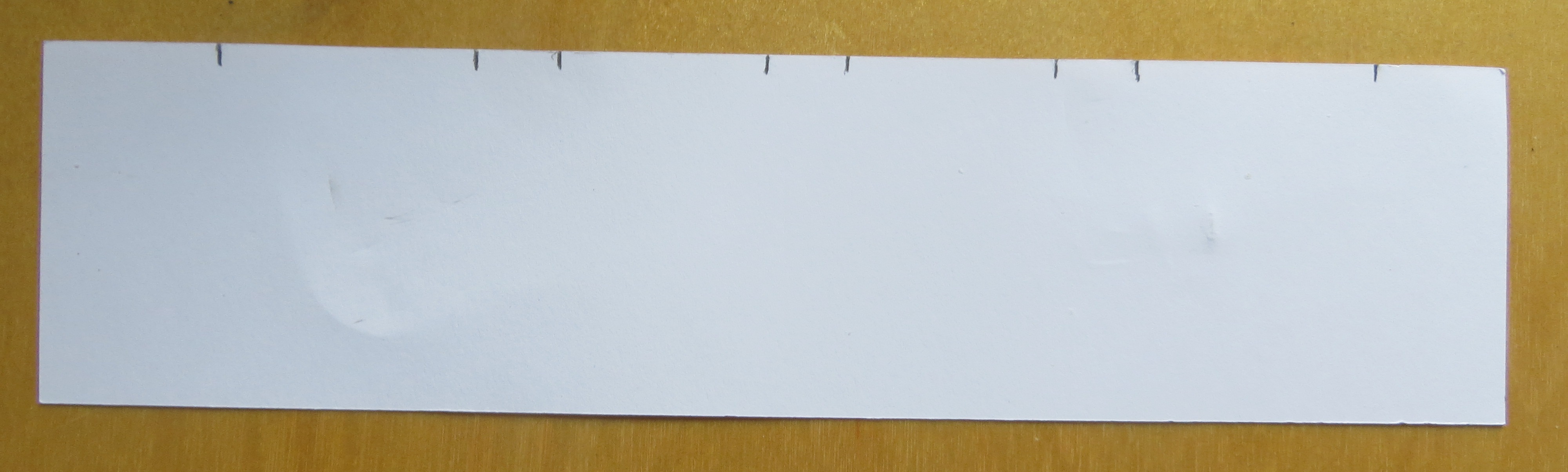
The book was created in Microsoft Word using a two column format and the ‘Book Fold’ Page Setup. Book Fold produces double sided landscape A4 pages which, when printed, are arranged so that the pages appear consecutively when all the pages are laid flat one on top of another and then the whole set is folded in half. This produces a bookbinding Section. I elected to have sections containing 16 pages i.e four A4 pages each with four half pages – two on the front and two on the back – and I ended up with 10 sections as you can see in the picture below.Sections are sewn together using linen thread and linen or cotton tape. A template is made to match the height of the book. The positions of where the thread will be sewn is marked on the template as shown below.

Excluding the extreme left and right positions on the template above, the space between where the thread is passed through the top of the section to the underside and then passed back up to the top of the section is the width of the tape. Each section is placed in a cradle in turn and, using the template, holes are pricked through the centre of the section at the positions marked on the template – if you expand the image below you’ll be able to see the pinpricks.

The sections are then sewn one after another with the thread being sewn around the tape. As the thread is taken from one section to another, the thread is knotted to bind the sections securely together.  Once all the sections have been sewn, a coating of EVA  glue is applied to the spine. The picture below shows the completed sewn sections.

This is where I got up to in my last bookbinding class. The next term of classes start in May, so I hope I’ll be able to recount how I made the covers, attached them to the sewn sections, and completed the book, towards the end of June.

Self-Thinking

This is not so much an idea as a commentary on other great ideas…. A couple of weeks ago, my friend, Richard Harper, gave me a book to read – ‘Writing The Self’ by Peter Heehs. I guess it came up in our conversation because of my writings in pwofc.com and because of my questioning about why I keep things. However, it turns out that it informs neither of those endeavours. Instead, it made me realise, first, just how little I ever learned about mankind’s greatest thinkers; and, second, that I’m really not sure all that great thinking would have been any use to me.

The book is essentially a quick run  through of the great philosophers and theologists and their most basic tenets in respect of The Self (they may well have pronounced on other great matters but this book sticks to their ideas about Self); which, so far as I can see, tend to have concentrated on answers to the simple questions of what we are and what we are doing in the universe. The answers seem to have been anything but simple – particularly as religion seems to have provided the excuse for huge amounts of rationalisation and speculation. Thankfully, as the book points out in its last chapter, the consensus among today’s philosophers, social scientists, cultural theorists and neuroscientists is that the self is a construct not a substance; and most people in modern society take selfhood for granted, and don’t bother theorizing about it. I’m not sure where that leaves the huge amount of writings that have been produced in the past on the subject.

The ‘writings’ focus of the book seems to have four aspects; first, the fact that ideas produced by the great thinkers were recorded in writing; second, from about the 16th century onwards, the thinkers started to use their own writings for self examination (the start of the modern diary); third, memoirs and autobiographies started to become commonplace in the eighteenth century; and, fourth, also around the eighteenth century, novelists started to explore the notion of the self – sometimes using the mechanism of diaries and memoirs as a vehicle for their fictional stories. Writings in the age of the internet – the blog and social media – are only given a brief mention in the last 7 pages of the book; and, disappointingly, I found only one half page passage (on page 170 regarding the Goncourt Brothers in the nineteenth century) referring to the survival of the personality through material artefacts, writings etc. –  there must be more of that out there somewhere.

I’m left feeling that I should appreciate more, glad that at least I’m aware there is more, and thankful that I am not driven to find out more. However, It would be interesting to hear from someone who is knowledgeable in these fields as to whether the past thoughts of the great thinkers on the subject of The Self still hold any sort of sway today.

Testing Alexa and Icon Allocation

Our Sounds for Alexa book includes 335 albums, of which 43 are self-made recordings, special promotional productions or audio books. The remaining 292 were deemed to have been commercially produced and widely marketed and therefore to have been reasonable candidates for inclusion in Amazon’s Music Unlimited library (which apparently contains some 40 million songs) which we now subscribe to. I successfully requested Alexa to play 189 of these, but the remaining 103 proved more problematic; either Alexa couldn’t understand what I was asking for or the album didn’t exist in the Music Unlimited library.  By searching the Amazon web site I determined that while 62 were not available in the library, 41 were present and should have been accessible via Alexa. I tried requesting these 41 a second time, but could only get 14 of them to play. This leaves 27 albums which Alexa should be able to play but which I have been unable to make a successful request for.

These statistics hide an extensive and sometimes extremely frustrating set of interchanges with our new house lodger. An example at the straightforward end of this spectrum was a request for the album ‘The Carpenters’ by The Carpenters  which consistently resulted in the album ‘Carpenters Gold’ being played. On reporting this foible via the feedback mechanism in the Alexa app, I received a very prompt reply from Amazon Customer Services confirming that this was incorrect and advising that the technical team had been informed.  Perhaps less easy to understand, however, were the 8 albums which Alexa seemed to have understood what I had requested  (she repeated the words back to me correctly), but said she couldn’t find the albums despite the Amazon website saying they were available in Amazon’s streaming service.

For the remaining 18 albums, Alexa just couldn’t seem to understand what I was saying. Sometimes she got close as, for example, with East of Eden’s ‘Mercator Projected’ album, she repeated ‘Mercato Projected; and for the album ‘Fongo’ by Los Chinches, she repeated ‘Fungo by Les Chinchillas’. For other albums, she was just way off as with Peter Sellers’ ‘Fool Britannia’ which she repeated as what sounded like ‘full returning to bratamella’.

For most of the problem items I had at least two or three goes each time, and sometimes Alexa simply got worse and worse rather than better and better. For example, Alexa’s first attempt at Tom Russell’s ‘The Rose of Roscrae’ was ‘rossel rescit’ and the second time around she moved on to ‘the runners of roscrae’. Likewise, her first attempt at the album ‘Let Spin’ by Let Spin was ‘ led span by led spain’; followed up with a second attempt in which she started playing Felice Civitareale’s album ‘Let’s go to Spain’.

Such interactions in the end become rather tiresome because the exchanges are all one-sided. Alexa doesn’t pick up on cues like a hoot of laughter at what she is saying, or the tetchiness in one’s voice as you say the same thing yet again. Of course, in normal day to day use, one wouldn’t be going through a whole list of problem items, so its unlikely that one would experience so many consecutive unsuccessful interactions. After all, Alexa’s overall success of playing 203 of the 230 albums that I believed she should be able to play, seems pretty good. However, this exercise has clearly highlighted the fact that the system has not yet been perfected. Furthermore, as well as the basic voice recognition issues, there are also a couple of other functionality shortcomings which Amazon hasn’t addressed – first, for albums consisting of more than one disc, there appears to be no way of specifying that Alexa should start playing Disc 2 as opposed to Disc 1; and second, there is no way of getting Alexa to move directly to a specific track number.

All the above insights came from my attempt to get Alexa to play every commercially available album in our book. Having completed all that testing, I was now in a position to allocate a colour coded icon to each of the albums. I ended up with the following three icons:

This item is part of the digital collection and can be heard by playing it on the iPhone; or through Alexa’s speakers by setting up a Bluetooth connection between the iPhone and Alexa. It is not available through Amazon’s Streaming Service.

This item is available in Amazons streaming service and can be listened to by requesting Alexa to play it.


Even if this album is not available in Amazon Music, it may be possible to get Alexa to play individual tracks from the album because they may be present in other albums which are available in the Streaming Service.

In the book, I have placed these icons directly between the album’s name and it’s cover art – as shown in the example below. Note that an album can have all or none or some of these icons.


I decided that I would allocate a Cloud icon to those 27 problem items which I have been unable to get Alexa to play, on the basis that they are available in the Streaming Service and that one-day Alexa may be able to play them.

With all the allocations complete, it was time to complete the printing of the book and to take it into bookbinding – more of this in my next entry.
PawdocDP Participants

The project to perform digital preservation on the PAW/DOC collection (PawdocDP) started at the beginning of 2017 with myself and four other participants: Matt Fox-Wilson (Ambient Design), Ross Spencer and Jan Hutar (Archives New Zealand ), and Nicolaie Constantinescu (Kosson). We have exchanged introductory emails (see below), and  the team is now reading background material to get up to speed with what the collection is and what state it is in.  We aim to hold a screen sharing conference call in March to demonstrate and explore the digital collection and its supporting systems. The introductory texts sent by each member of the team are shown below.

From: Paul Wilson [mailto:pwilsonofc@btinternet.com] Saturday, 14 January 2017 12:15 a.m.

Hello Ross, Jan, Nicolaie and Matt. Very pleased to have you all on board at the start of this project undertaking Digital Preservation on the pawdoc collection (PawdocDP). To give us all some background on each other, I suggest you reply-to-all to this email with a brief intro about yourself. My intro is below. I’m a retired computer consultant living in Lavendon between Northampton and Bedford in the UK. I got a degree in Ergonomics from Loughborough University in 1972 and got my first job with Kodak where I first started working on the application of computers.  In 1978, I joined the UK’s National Computing Centre where I investigated best practice in Office Automation – that’s when the pawdoc collection came into being. I then spent 28 years with Computer Sciences Corporation (CSC) as, first, a computer consultant, and then as a Bid Manager for IT outsourcing deals. During my professional career I’ve been particularly involved in Office Systems, Requirements Analysis, Process Definition, Workflow Technology, HCI, CSCW, and Architecture Definition and Management. I play golf, and collect stamps and first edition books. My study window looks out on a side road with open fields beyond and 7 wind turbines in the far distance.

From: Constantinescu Nicolaie <kosson@gmail.com> 16 Jan at 7:25 AM

Hello! I’m an information architect for a library and information science community online – kosson.ro and a private enterprise manager. I have been involved with building useful content for all parties from my country that are interested in digital practices and resources preservation since over 10 years now. Right now I’m toiling on a JavaScript manual in Romanian needed so much for a solid foundation that will be followed by a series of data management for librarians. My languages is JavaScript and the Web APIs. Part of my time is dedicated now to writing essential learning materials and advocating for Open Access in Romania.

From: Ross Spencer < Ross.Spencer@dia.govt.nz> Monday, 16 January 2017 7:34 a.m.

Hello everyone! Thank you Paul.  I am a digital preservation analyst at Archives New Zealand. My background is in software engineering and digital humanities. I have worked at Archives New Zealand for three years, and before then, The National Archives, UK. My primary interests are developing tools for others to use to analyse and sentence digital records within an archival context. I release open source tools on GitHub. My languages are Python and Golang, with a modern day preference for Golang because of its easy portability across platforms without the need to run an interpreter. Outside of work I’m still a programmer, but, I’m also a cyclist. Interested in movies and music. I’m also attempting to learn French – but I have been attempting that endeavour for a long long time now!

From: Jan Hutar <Jan.Hutar@dia.govt.nz> 17 Jan at 11:33 PM

Hi all, Similarly to Ross I am a digital preservation analyst at Archives New Zealand, same role, different focus as you would expect. My background is classic archival science and then libraries. Before joining Archives NZ in February 2012 I was at the National Library of the Czech Republic in Prague, managing the Digital preservation team there for 5 years. I have got a PhD, my dissertation was about metadata for digitisation and digital preservation, the proposed metadata standard and schema is being used across Czech republic libraries since 2012. My main focus at Archives NZ is keeping our digital preservation system in shape, managing the data in it, getting data in and dealing with all sorts of digital preservation problems. Also digital preservation related policies. Mountain biking is my thing.

From: Matthew Fox-Wilson <ambientmatt@me.com> 22 Jan at 9:52 AM

Hi everyone, Sorry for the slow introduction! My exact job is sort of hard to describe but technically I’m the director/owner of a software development company here in New Zealand specialising in creative software for the consumer / prosumer market. My main focus here is on application architecture and UI design, but I’m also responsible for coding application structure and front end systems for our products. We’ve been in operation since 2001 but before then I’ve worked for a variety of companies in NZ and remotely for the US on consumer and pro-level graphics software, and consulted on a variety of projects relating to data sorting and natural methods for presentation, hence my interest in this project. When I’m coding I’m mainly old-school, focused primarily on C++ with a bit of Objective C, for Windows, MacOS, and iOS. Outside work I enjoy trying to recover from work, which mainly takes the form of gym, running, and a sword based martial art.

Sounds for Alexa

Having decided to create a book listing all our albums, I soon realised that there were a couple of other things that could be included. First, there are several albums that I no longer have but which I have fond memories of. Second, for the last 4 or 5 years I’ve been reading The Guardian reviews of new albums and listening to samples of their tracks in the Amazon site and including those I particularly like in my Amazon Wish List. By subscribing to Amazon Music Unlimited, all these albums should be available to listen to through Alexa, so I’m going to include these in the book as well.

Since every album in the book would be playable either directly by Alexa or on the iPhone through Alexa, I decided to create simple colour coded icons for each of those mechanisms and to allocate one or both to every entry. To make it a bit easier to use the book in conjunction with Alexa, I’ll top and tail the book with some guidance about using Alexa, and with an index to the artists listed in the book. I also decided to leave some blank pages at the very end of the book so that there will be space to handwrite new entries as we discover new music that we like. All these elements combine together into the following Contents list:

  1. Su & Paul’s Digital Sounds Collection (Individual Artists, Various Artists, Singles, Soundtracks, Spoken Word)
  2. Albums that Paul has sampled and likes
  3. Albums that Paul likes but hasn’t got
  4. Albums that Su likes but hasn’t got
  5. Index
  6. Additional Entries

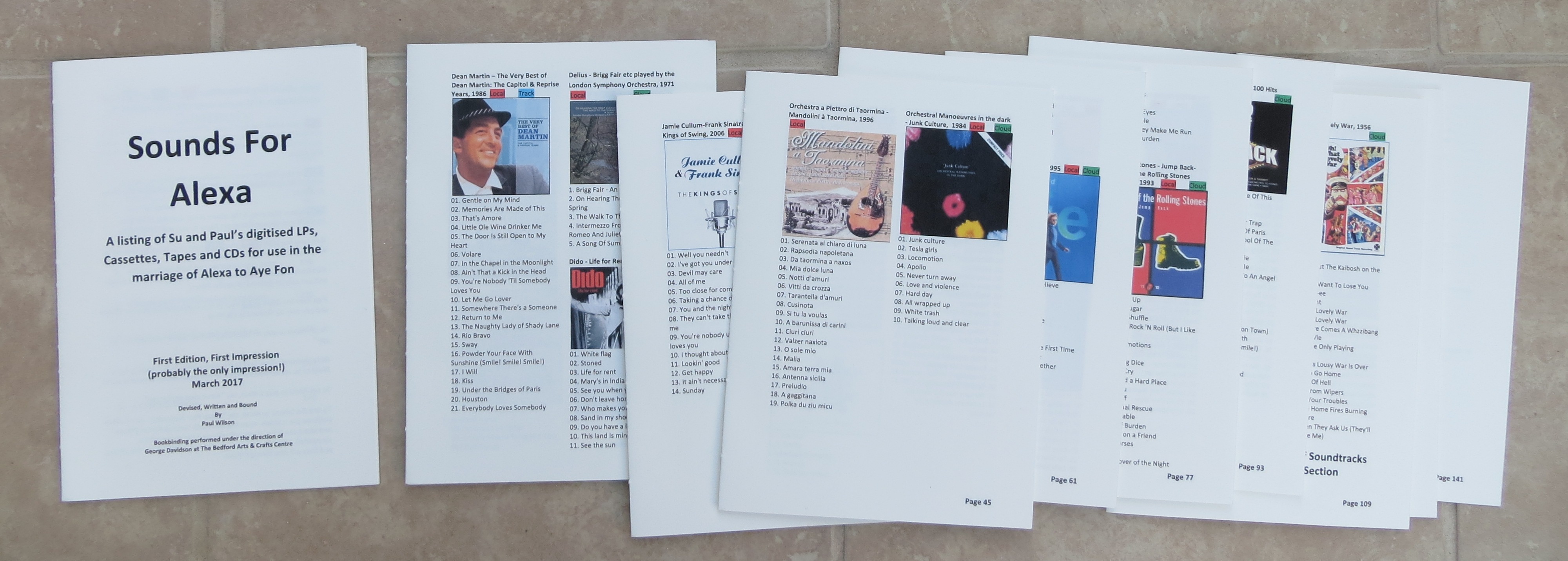
The title of the book has to reflect the fact that it contains more than just music, so in the end I decided to go with ‘Sounds for Alexa’ with a sub-title ‘A listing of Su and Paul’s digitised LPs, Cassettes, Tapes and CDs for use in the marriage of Alexa to Aye Fon’

With this structure in place I set about populating the sections. For our digitised collection I was able to draw on the digital folders and files for the titles and album art. I also included the track list underneath each album picture, by using Microsoft’s ‘Copy as Path’ function (select all the sound files in an album, hold down the shift key and right click the mouse). If the result is pasted into excel, it’s a simple matter to copy the whole of the standard path in front of the actual track names, put it into the Find and Replace tool, open up the replace section with zero contents and do ‘Replace All’. This deletes all the path information. The ‘.mp3’ extension at the end of the file names can be removed in a similar way. This leaves just the track numbers and titles which I then copied into the Word document.

The Amazon Wish List material was simple enough to copy and paste into the book – though I didn’t attempt to try and find track titles for each album – that would have been a step too far! The final section – albums I would like but haven’t got – was again populated by finding the album concerned within Amazon and copying and pasting the relevant information.

Although this initial population of the book was very time-consuming, it was at least relatively straight forward. The next phase – finding out what Alexa could and couldn’t play – was considerably more demanding.

Alexa’s Arrival (and I Start Bookbinding)

Alexa arrived at our house last December accompanied by glowing references regarding her musical abilities and her speaking skills. Within an hour or so she had found a spot in our kitchen-diner and had settled in.

Alexa is, of course, Amazon’s Echo product whose main feature is that you use it by talking to it – no screens, no keyboards, just the word ‘Alexa’ and then whatever you want to request. For example, ‘Alexa, play BBC Radio 2’, or ‘Alexa, play the album 25 by Adele’.

Su had seen an advert and I had looked up some reviews on the net which were pretty complimentary. We realised that, as well as enabling us to play our digitised music, Alexa would give us access to radio stations. The sound quality was reported to be very good, and the device itself was a relatively small cylinder which would take up very little space. We found a good deal from John Lewis (reduced from 149.99 to £119.99) and duly placed our order.

At first, we just relished the ability to call up UK radio stations (and I even managed a station from as far afield as Singapore); and then I figured out how to get Alexa to play the music on my iPhone using a Bluetooth connection. Following some suggestions in the weekly ‘What’s new with Alexa’ email, I tried Alexa’s multiple choice adventure game, asked her to tell me a joke, and set up the Jamie Oliver add-on (or ‘skill’ as add-ons are known in this Amazon world) to get some advice on recipes. Finally, when we realised that Alexa could play just about any song or album, we took advantage of Amazon’s offer of a free month using Amazon Music – and then just rolled over and took out the £3.99 a month subscription.

It was a significant moment. In the space of about 6 weeks we had overcome two of our longstanding problems – a) not having a decent sound system with our record collection sitting next to it, and b) not being able to get good quality radio reception. However, there was still one facet of this arrangement which falls short – it’s not possible to glance across a shelf of CDs to look for inspiration about what to play.

It was a completely fortuitous coincidence that around this time I had enrolled on one of the very few Bookbinding courses in the UK at the Bedford Arts and Craft Centre some 20 minutes away from where I live. As I started creating my first book – a 160 page A5 notebook with blank pages – I started to realise how that final shortcoming of our Alexa setup could be resolved: I could create the ‘bookshelf’ of all our LPs, tapes and CDs in a book which we could keep next to Alexa. The book would include the album covers so you could flick through and let your eyes be caught by familiar images; and it would specify whether each album could be played by Alexa or would have to be played on the iPhone through Alexa. Having recently completed the digitisation of all of our albums, I knew that I had all the information and album art in my laptop; and with my rudimentary knowledge of book binding, I was pretty sure I could assemble the material in a Word document that could be printed out in the form required to create a book. With a growing sense of doing something rather interesting, I embarked on structuring the book and setting it up in Word.

Ripping Yarns

I completed ripping (copying) the second batch of our CDs (about 80 of them) a couple of days ago, and am now working on the order of service for Alexa’s wedding. But before we go into that, I’ll recount some of my experiences of digitising CDs.

The ripping software I’ve been using is Windows Media Player (WMP) – an easy choice since it comes bundled and free with the Windows operating system. WMP provides an option to require it to automatically rip any CD that’s inserted into the computer’s CD player. So, ripping 80 or so CDs is not such a difficult job. You just push the CD into the slot, let the software get on with it, and do nothing else until the tray is ejected and you can replace the CD with another one.

WMP places the contents of a rip into a folder that you pre-specify as another option (I’ve specified the ‘My MUSIC’ folder). It creates a main folder for the artist, and then a sub-folder for the album into which the actual track files are placed. There are some exceptions to this structure: compilation CDs are placed into a main folder labelled ‘Various Artists’ and film or stage music is placed into a ‘Soundtrack’ main folder. WMP is able to pick this information up from the ‘Properties’ of the track files (more of this later). I have added a few other main folders to accommodate some of the material that I have digitised from tapes and LPs – a ‘Spoken Word’ main folder for tapes of friends and family talking, and for audio books; and a ‘Singles’ main folder for our old 45 singles record collection and other singles compilations. To give you an idea of volumes, I now have 283 ‘album’ folders within 135 main ‘artist’ folders, and this whole set of material takes up about 22Gb.

The quality of the information that WMP puts into these folder names and into track file names when it rips a CD, is entirely dependent on the quality of the information on the CD. For CDs issued by large commercial record companies, the information is usually complete and correct. However, I have come across CDs with a variety of problems such as incorrect album date, information for a completely different album, and no information whatsoever. When WMP encounters missing information, including missing album art, it will automatically try and find it on the net (provided you have accepted this default WMP option). Should it be unsuccessful the only thing you can do then is to manually input the missing information into the Properties of each track file.

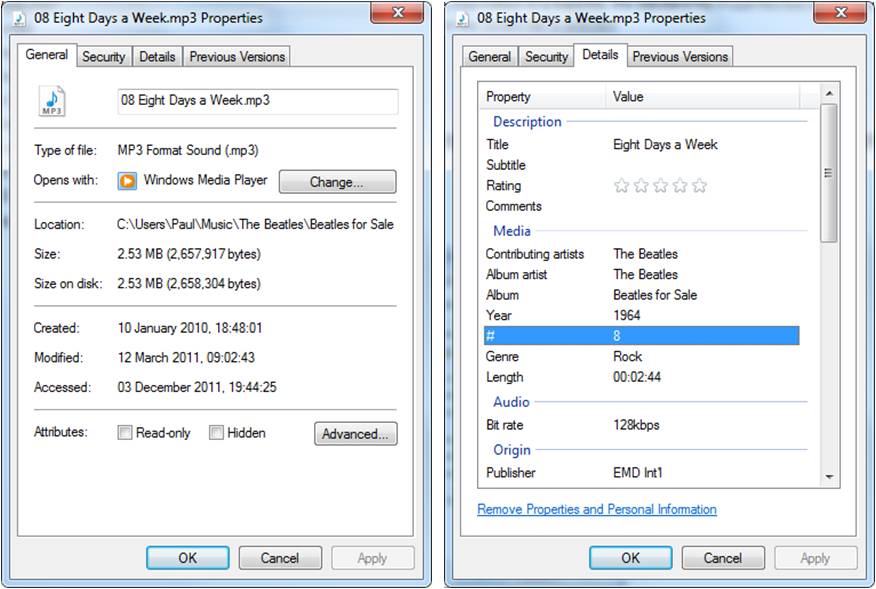
To adjust the information in a track file, the standard file Properties box is opened in the normal way, and then the Details tab is selected (see examples below).

The Details tab contains a large number of information fields, however the ones I’ve found to be worth getting right are:

  • Title (it is this Title and not the file name that appears in WMP)
  • Album Artist
  • Album
  • Year
  • Genre (I think you can specify anything in here)

In cases where there is no information on the CD and WMP hasn’t been able to find it on the net, I’ve just had to take the information from the CD cover and manually type it in. Of course, for tapes created at home of people talking etc. all of this material has to be created from scratch – including the Album Art jpg file which WMP uses to display the album in its library. However, once the relevant files have been populated, the album and its individual tracks will appear in the WMP library. If WMP can’t find an Album Art jpg file it will display a blank icon with a musical note in it. I find this unsatisfactory and go out of my way to provide a  picture of some sort or another. In my experience, much album art is available somewhere on the net, however, if I can’t find any, for music CDs I scan the covers that come with the physical CD; and for LPs (which are too big for my scanner), I take photos of the sleeve and then crop it to the exact size. For tapes that I have created myself of people talking etc. I have tended to either use a relevant photo or to construct an appropriate picture in PowerPoint.

Having completed all this work, I can now see all my album covers in the WMP library; can search on album titles, artists, track names and genre; can play all this material on my laptop; and have downloaded it onto my iphone for listening to when away from the laptop. However, it still hasn’t really solved the problem of not having all the physical CDs next to a CD player in a room where you can look through the collection, choose something to listen to and slot it into the CD player. However, it was the arrival of Alexa that spurred this final batch of ripping, and it is the marriage of Alexa to my iPhone (using some surprisingly old technology) that I’m hoping might go some way towards addressing this shortcoming. I’ll describe how in my next entry.

How the technology escaped us

It was back in 2008 that I started to digitise our tapes and remaining LPs. Now we’re on the final leg of this digitising journey and soon will be up to date with the technology after we’ve finished arranging Alexa’s marriage. But I’m getting ahead of myself. First let me describe how we got started.

Like everybody else, we were left with large collections of LPs and cassette tapes when CDs started to make their mark. We replaced those which had Compact Disc versions and which we liked best, with their CD counterparts. However, by 2008 we still had some left, as well as a reel-to-reel tape and a number of cassettes with recordings of events, family and friends. It was clear that unless they were digitised we would eventually have no equipment to play them on. So, I acquired a Numark TTUSB turntable with a USB audio interface, downloaded the free open-source Audacity recording and editing software, plugged in an old ghetto blaster cassette deck, and set about digitising the remaining LPs and cassettes. It wasn’t particularly difficult – though it did take a while to establish how to set the most appropriate recording levels, and to become familiar with Audacity’s editing functionality.

The 9 inch reel-to-reel tape was a different kettle of fish. I had no such equipment of my own and didn’t know anyone who had one. However, I did have a friend who used to work in BBC radio and she put me on to an ex-BBC sound engineer who retrieved the contents and put them onto a CD for me for a small fee (which my friend very kindly paid – thank you, Vanessa!).

It was about a year after this that my daughter gave me an iPod Nano for Christmas and that was the spur for me to rip all the CDs in my study (as opposed to the household’s collection of CDs downstairs) and to download them, as well as all the other music and spoken word material I had previously dealt with, onto the tiny device. I took great pleasure in being able to bring all this material to life by having the ipod play random selections using its ‘shuffle’ feature whenever I turned my laptop on in my study.

In the meantime, our main household music collection was now held entirely on CDs and was played on either the TV’s DVD box in the lounge or on a wall mounted CD player in the conservatory.  The main CD collection was held in a separate downstairs room, and a small subset of CDs was kept on the conservatory window ledge. This wasn’t really a satisfactory arrangement since a) we didn’t use the TV’s CD player capability very much at all; and the main CD collection was stored well away from our only CD player; but it worked for when we needed to play some music.

Meanwhile, the world was storming away with new hand-held devices designed to, among other things, play music; with new music services like the Apple Store; and with new (quite expensive) digital music systems, such as Sonos, designed to store digital music and play it on dedicated speakers throughout the house. In 2012, I acquired an iPhone and put some music onto it – though I can’t say I listened to it a great deal. I also set my laptop up to act as media server and acquired a dongle for our lounge TV so that we could select music residing on my laptop and play it through the TV. Again, we only used that capability infrequently for parties and the like because, apart from having to ensure the laptop was switched on and not in sleep mode, the search and retrieval facilities through our TV are very cumbersome).  There was no further change in our household music situation until we moved house in 2015 and moved the CD player into our kitchen-diner room – though the CD collection was still held separately.

For the last couple of years I’ve been hearing more and more about Spotify – mainly from my son-in-law and daughter who use it as their main music source. They seem to have done away with the notion of a music collection and just call up whatever they want to listen to. I’ve been impressed by what you can call up, but not enough to actually decide to sign up for such a service and to install the necessary speaker systems in the house.

In actual fact, we’ve just been left behind by a series of technology changes that we don’t fully appreciate or understand. We started out in our youth by listening to our favourite LPs over and over again on music centres which also played cassettes and the radio; and, despite all the technology advances, we now listen to music much less often – and probably watch more TV than we used to. I suspect it’s not an uncommon story. If we’d had lots of spare money, I would have been inclined to just install a Sonos-type system throughout the house; but we haven’t got unlimited funds and somehow music has never been at the top of the priority list while we’ve been able to play what we want to listen to in some way or other.

However, everything changed for us towards the end of last year when Alexa arrived….. to be continued….

Collaborators sought – and found!

I started digital preservation work on my pawdoc document collection by first recruiting my son, Matt Fox-Wilson, to help with the project. Matt is the co-owner/developer of the ArtRage natural painting software package, and his experience as a software engineer is likely to be of use in the work. I then sent out the following request to other potential collaborators via the JISC Digital Preservation email list:

————————————————————————————————————

From: Digital-Preservation Announcement and Information List [mailto:DIGITAL-PRESERVATION@JISCMAIL.AC.UK] On Behalf Of Paul Wilson
Sent: Wednesday, 7 December 2016 5:53 a.m.
To: DIGITAL-PRESERVATION@JISCMAIL.AC.UK
Subject: Learning opportunity for digital preservation in document management systems

Collaborators are sought for a digital preservation project on a collection of some 40,000 documents stored in a document management system. This will be an ideal opportunity to gain practical experience of a variety of digital preservation challenges in an informal, small scale environment, unfettered by organisational constraints.

The project will apply the preservation planning methodology developed by Paul Wilson and published by the Digital Preservation Coalition in May 2016 – see http://dpconline.org/component/docman/doc_download/1509-casenotepwilsonpreservationplanningver2

The project will start early in 2017 and is likely to last for between one and two years. Collaborators will be expected, as a minimum, to familiarise themselves with the background and high level contents of the collection in question, to comment on the preservation planning documents that are produced, and to participate in the project meetings at which decisions are taken. Such participation need only be remote and will probably take up about one day a month excluding the time spent on familiarisation. However, it is hoped that participants will wish to benefit from the project in more substantive ways; they will be encouraged to play a full part in the decision making that will be required and in the detailed preservation work itself. Such involvement will be determined in the course of the project. It is anticipated that the learnings from the project will be written up and submitted for publication.

The project is likely to be of particular interest to collaborators who have experience of managing collections of Personal Archives, or who work in organisations that own such collections. Location is not a constraint for participation, however people and organisations from the UK and New Zealand are particularly encouraged to get in touch. Interested parties should contact Paul Wilson at pwilsonofc@btinternet.com

————————————————————————————————–

I had two responses and am currently confirming the involvement of the people concerned. Things are looking good for commencement of the project in January 2017.