
The Life-Changing Magic of Tidying

Marie Kondo’s book ‘The Life-Changing Magic of Tidying’ is definitely worth a read, especially for those with a general interest in the topic of introducing some order into a pile of chaotic objects, and also for those who have even a vague feeling that they would like to live in a tidier home. Her experience and passion for the subject jumps out from just about every page with an almost religious fervour. However, I’m happy to say that, towards the end of the book, she says quite unequivocally “tidying is not actually necessary”,  “You won’t die if your house isn’t tidy”, and “tidying is not the purpose of life”; hence, for those with a desire to give it a go, she espouses doing a complete assessment of every item you possess as quickly as possible to get it over with. Having done so, she believes you will have a changed mindset, and that you will naturally continue to keep things in order.

While there are many points in the book that are of great relevance to the investigations in this blog, there are two major differences; the book makes hardly any reference to digitising things, whilst harnessing the power of digitisation is a key thrust of these investigations; and the book is focused on tidying ALL of a person’s possessions in their home (or their place of work), whilst this blog is looking at particular subsets of a person’s possessions. Having said that, the approach, rationale, and impacts that are described can all contribute to the understanding that I am trying to explore in these pages.

Kondo’s approach is pretty straightforward. Take a category of your belongings; assemble EVERY item in that category from EVERY part of your house, into a big pile; take each item, hold it in your hand, and decide if it gives you a spark of joy – If it does, keep it, and if it doesn’t, discard it; assign a specific space to store everything you keep; when you store  things, make them as visible as possible, and avoid piling things one on top of the other. This process is intended to be a one-off, all inclusive, exercise to be done on every possession you have.  In Kondo’s experience it usually takes about half a year.

The two key questions, of course, are what constitutes a spark of joy, and is having a spark of joy for an individual item the only criteria one should have. Take books. I love books and enjoy having them around me. Some of the individual books I have are less meaningful to me than others; but I’d keep them for the sake of having books on bookshelves around the house. Kondo doesn’t seem to recognise this. In the several examples she quotes about books, the outcome always seems to be the disposal of tens if not hundreds of books. To be fair, she does make it clear that the decision about what to keep has to be made by the individual concerned. I guess she would just advise that, in the absence of a spark of joy, you should be clear about why you are keeping something.

I don’t think I came across an explicit answer in Kondo’s book to the question ‘why bother to keep your house tidy?’. However, it contains a number of assertions which collectively suggest it’s a good thing to do. The simplest assertion is that one of the reasons why clutter eats away at us is because we have to search for something just to find out if it’s even there; so if we have a tidy house we can find things easily and quickly and feel more content. Another is that we keep things because either we become too attached to the past or that we have a fear of the unknown  future. Kondo believes both things hold people back in their lives – being too attached to the past means that we can’t move on; and having a fear for the unknown future signals our reluctance to try out new things. However, Kondo’s overall rationale is even more complex than that. She believes that we fail to get to grips with clutter as an instinctive reflex to avoid thinking about the other issues in our lives. By discarding the things that are not truly precious to us, we are better able to see what is important to us; we are able to address the issues that are troubling us; and we can become more content with our lives.

Are any of these valid points? And if so, are they good and sufficient reasons for being tidy? To take each one in turn: a lot of clutter undoubtedly makes it more difficult to find things in most cases. However,  there is anecdotal evidence that some untidy people can still find the things they need by having a clear memory of where they place things.  In general, though, it seems reasonable to assume that being tidier can help many people find the things they need more quickly.

The notion that being untidy may be constraining people from moving on or from being able to try out new things, I feel is a more tenuous point: I think I have known many untidy people for whom these assertions are totally untrue. The best that can be said is that it may be constraining some people. As to whether a thorough tidy can help those people – well, according to Kondo’s experience with what sounds like an extensive client list, it seems that this is probably true.

Kondo’s final, rather bold, assertion that a thorough tidy can help us address issues that are troubling us and change our lives, is one that I have no way of assessing. Again, we have to rely on Kondo’s own experience with her clients – apparently, she has observed this occur many times, so we can only assume that, for some people who try out her approach, this is a possible outcome. Even if it’s only a possibility, for those who are seeking to address such issues, it may be a good reason to try out Kondo’s approach.

Now, turning to the impact that Kondo’s approach has on people, the most tangible and immediate impact seems to be the disposal of numerous bags of possessions. The numbers quoted are rather large:

  • ‘I threw out 30 bags of rubbish in one month’
  • ‘After three months of this strategy I had managed to dispose of 10 bags of rubbish’;
  • ‘The minimum amount of paper waste that my clients dispose of is two 45 litre bin bags – the maximum so far is 15 bags‘
  • ‘[one client] had no qualms about discarding and at our first lesson she got rid of 200 books and 32 bags of items.’
  • ‘The record number of bin bags filled to date was by a couple who threw out 200 bags worth of rubbish plus more than 10 items that were too large to put into bags.’
  • ‘The average amount thrown out by a single person is easily 20-30 45 litre bin bags and for a family of three its closer to 70 bags.’

These are big numbers and I found myself wondering a) if they are all shopaholics in Japan (where Kondo is based), and b) if they weren’t filling the bags to their capacity. But, anyway, it’s clear that disposing of such large amounts of stuff would probably make a very tangible difference in an average house.

Other impacts that Kondo cites are largely to do the mindset of the individual. She claims that ‘Tidying dramatically changes one’s life. This is true for everyone, 100 per cent.’ Particular changes she describes include the following:

  • One of the magical effects of tidying is confidence in your decision-making capacity. Tidying means taking each item in your hand, asking yourself if it sparks joy, and deciding on this basis whether or not to keep it.  By repeating this process hundreds and thousands of times, we naturally hone our decision-making skills.
  • Because [my clients] have continued to identify and discard things that they don’t need, they no longer abdicate responsibility for decision-making to other people. When a problem arises, they don’t look for some external cause or person to blame.
  • Putting your house in order will help you find the mission that speaks to your heart. Life truly begins after you have put your house in order. “When I put my house in order I discovered what I really wanted to do.” These are words I hear frequently from my clients.
  • Through tidying, people come to know contentment. After tidying, my clients tell me that their worldly desires have decreased.

These are dramatic changes – but then the process that Kondo guides her clients through is also quite dramatic so perhaps it’s not unreasonable to expect some significant impacts on people’s lives.

So far I’ve really only spoken about the book’s general approach and impacts. However, it also provides a wealth of detailed and very useful guidance on how to deal with specific types of objects and on setting up different types of storage.  There is too much material to discuss here, but I’ll finish this summary with just a couple of quotes which I particularly liked:

  • A common mistake people make is to decide where to store things on the basis of where it’s easiest to take them out. This approach is a fatal trap. Clutter is caused by a failure to return things to where they belong. Therefore, storage should reduce the effort needed to put things away, not the effort needed to get them out.
  • Mysterious [electrical] cords will always remain just that – mysterious.
What’s in a Name?

The term Order From Chaos is widely used in many different contexts. A quick search on Google reveals that it appears in areas as diverse as Heavy Metal music, foreign policy, and science. I remember coining my own use of the term in the late 1980s when, standing in the shower in Stoke Mandeville, I faced the fact that I would never be able to employ the acronym IFC (Interplanetary Freight Corporation), but realised that, with a small change of letter, I would have a name, OFC, which reflected a real interest of mine which I could explore, develop, and exploit.

While I haven’t come across any other people investigating this exact same meaning of the term, there are, nevertheless, some who are doing things that are closely related. Two in particular seem to be highly relevant and have books which are easily acquired and consumed: Marie Kondo (The Life-Changing Magic of Tidying: a Simple Effective Way to Banish Clutter Forever), and Liz Davenport (Order From Chaos: a Six Step Plan for Organising Yourself, Your Office, and Your Life).  I’ve decided that I need to read these books before I set about drawing some general conclusions from the work recorded in this blog. My musings on their contents will appear in the next couple of posts.

DuvBag

If you want to use your own bedding while you’re away, a duvet with a built in undersheet – rather like an oversized sleeping bag – would do the trick. It would also eliminate the need for the people you’re staying with having to wash the bedding after you’ve left.

OFC as a Service

When I first started thinking seriously about these OFC ideas back in 2004, I set about trying to turn an intuitive art into a clear repeatable process. I produced three documents  of which only the White Paper has appeared in this blog. The other two are essentially draft documents which have not been properly tested and refined; however, I’ve decided to include them here as they do at least provide an indication of the sort of detailed activities that OFC entails. They are a Service List and a Process List. Both incorporate the notion of charging for the service – though that is by-the-way; I no longer have any ambitions to create a business, though I would dearly like to be able to try out my ideas on some real world collections of objects which belong to someone else and with which I am not already familiar. The OFC exercises documented within this blog have been informative but are almost certainly not sufficient to be able to define a fully generalisable process.

I have applied OFC techniques to one set of material that was not my own: it consisted of 6 large egg boxes containing the stamp collection of an old friend’s mother who had died. My friend is not a stamp collector and was having trouble disposing of the collection. I am a stamp collector so I was excited by the prospect of both exploring the collection and having the opportunity to apply some  OFC techniques. In my first encounter with the material I took about three hours to go through it all, divide it up into the major categories, and get an overall picture of what it consisted of. I agreed with my friend that I would sell the material through Ebay, so subsequently sorted it into sub-categories that I thought would interest potential buyers. I ended up with approximately 37 Lots which I proceeded to sell on Ebay over a 3 week period. For each Lot I took photographs and wrote a description for it’s Ebay entry; and I managed what I was doing in a Word document which contained the following information for each Lot:

  • Ref No
  • Title (for use in the Ebay entry)
  • Description (for use in the Ebay entry)
  • Two or three of the 12 free photos allowed by Ebay
  • Weight (for use in estimating postage costs)
  • Size (for use in estimating postage costs)
  • Postage (type of service and cost)
  • Date put into eBay
  • Disposal if not sold in Ebay (which could include ‘re-list in Ebay’)
  • Date auction ended
  • No of bids
  • Amount paid by buyer
  • Paypal fee
  • Ebay fee
  • Packing costs (if any)
  • Actual Postage Costs
  • Net amount after all expenses
  • Date sent
  • Buyers name and address

I was able to give a copy of this document to my friend as a permanent memento of her mother’s stamp collection. This was an instructive experience, and I continue to look out for other opportunities to try out OFC techniques.

Berko Dérive

A week ago I had a taster of how to explore intuition. It wasn’t something I’d signed up for, or even expected. It was just a catch-up meeting after about 15 years with my friend Clive Holtham of City University’s Cass Business School, who had originally helped me establish my electronic document management system, and with whom I have had many thought provoking and inspiring conversations about new office technology and its uses. I figured that, after five years of doing Order From Chaos stuff, it was time for another dose of reflections, imaginations and nugget exchanges with him. I wasn’t disappointed.

We had arranged to meet outside Berkhamsted station at 09.53, and the first thing we did was have coffee in the station’s high ceilinged and rather grand, in an old style renovated with 5 video cameras focused on every doorway, sort of way. We sat down and with little ado Clive provided me with my A5 journaling notebook and my Derwent Water Brush Pen for enhancing crayon marks. He gave me a tour of the crayon pencils and water based crayon pens and the pencil case we were to share, all the while explaining how we were going to journal our Dérive (check it out in Wikipedia) through Berkhamsted and why. Interspersed, of course, with both our numerous questions, accounts of our experiences, and our descriptions of related work.

We started to write, or, I should say, crayon and brush and illustrate, our journals. I noted that Dérive involves Noticing, Conversation and Storytelling (using the five senses, as Clive alerted me during our walk). When I started describing my Order From Chaos activities, Clive immediately chipped in saying that we need more Chaos, not less, to get us out of conventional thinking and rote responses. A few exchanges later we agreed there is probably a compromise to be had.  Clive advised me to look out a David Snowden paper which directly addresses getting order form chaos (and includes a model) which clearly I shall be looking for very shortly in Snowden’s ‘Cognitive Edge’ website.  I used a page to write down VUCA (Volatility, Uncertainty, Complexity, Ambiguity) and to highlight its distinction from the conventional and craved-for utopia, SCSC (Stability, Certainty, Simplicity, Clarity).

Eventually we started our walk and found ourselves on the tow path of the Grand Union Canal. We continued to talk; we stopped, admired, examined, exclaimed, took photos (Clive takes many photos  and stores them all in dated folders) and drifted on. We came across an access cover to the fibre optic channel laid along the tow path of the industrial revolution’s super highway; and we encountered two brass rubbing plates describing Berkhamsted history with a notice advising us to visit a website (our equipment proved not to be up to brass rubbing so we resolved to obtain charcoal and sugar paper at an art shop if we could find one). We spoke to a lady about the butterflies and pleasantness of the place; we discussed architecture; we saw a very large monkey in a conservatory (almost certainly not alive); we talked about art deco on the high street; and we encountered more monkeys in an antique shop and noted a pattern. We went in to an art shop which told us that, no, they didn’t have charcoal or sugar paper (brass rubbing plaques on the canal – oh really?!) but that there was an art and craft shop further up the high street which almost certainly would have them.

For lunch, we took up the offer of doing market research on fizzy drinks and duly sampled three different versions of three different drinks (I had Cream Soda, Ginger Ale, and Fizzy Orange)and were asked to provide all sorts of complicated observations about how they looked and tasted (Clive deliberately used all his five senses) in answers involving the five possibilities very good, good, average, not so good, poor (or equivalents); and which eventually one couldn’t distinguish between and just became approximated to average so that we could get to the food part of lunch which was a chocolate bar or chewy sweets for our troubles.

We found the art and craft shop which turned out to be a veritable cornucopia of different and unusual stationery items of immense use in the pursuit of Art-Based Management Education and Order From Chaos exercises. The Assistant helped us with charcoal, and the Proprietress sorted out our paper (two particular types just to be sure) and we left satisfied that we could now rise to the challenge of canal-side rubbing. Outside the Art & Craft shop, I asked Clive if he had heard of ArtRage and he said he’d been using it for the last ten years – an excellent product. I mentioned that  my son was the owner (I should really have said joint owner  – well, joint developer, builder and owner) and we laughed, amazed at the connection.

Outside the sun continued to shine. We found another place to park the car – this time for free and by the canal. We sat on a bench to put more stuff into our journals and I watched a man on the grass, thirty feet away, tickling a swan on its side while it pecked his other arm as if licking the salt like a dog would do. It was something I had never seen or even imagined. We crayoned and discussed, and drew and brushed the water paints. We talked about Buckminster Fuller, about hexagons (so much better for fitting together than Post-Its,) and about encouraging students to first do Notetaking, then to do a quick read with Basic Reflection; and finally to undertake Deep Reflection. Clive remarked that Schools progressively remove imagination from pupils and that any that is left is surgically removed by the universities.

Eventually, we had  another stroll along the other tow path and found curious outdoor gym equipment without instruction but maybe for back stretching. Then we came across another brass plaque. Clive attacked it with gusto, trying first the thinnish paper with the charcoal (just didn’t work) then triumphing with a black crayon on the newsprint paper. With this victory documented in several photos, we found our way back to the car, drove to the station, and had an ice cream before Clive caught the 4.01 to London.  I drove home with my Journal, my Water Brush Pen, my 40 rouble Water Colour Pallet, and an A7ish booklet of the Reflective Practitioner Exhibition 2017 printed by Boots from a Snapfish account.

Of course the above description can’t convey the richness of our conversation nor the extent of our exchange of knowledge; but I hope it paints the dreamlike context with which our minds were opened and new pathways were discovered – just as Clive intended.  Days like that don’t come around very often; so it will stick in my mind and will ooze out across my thinking for many days and weeks to come; and will almost certainly colour my thinking about this particular Order From Chaos journey.

An OFC Model

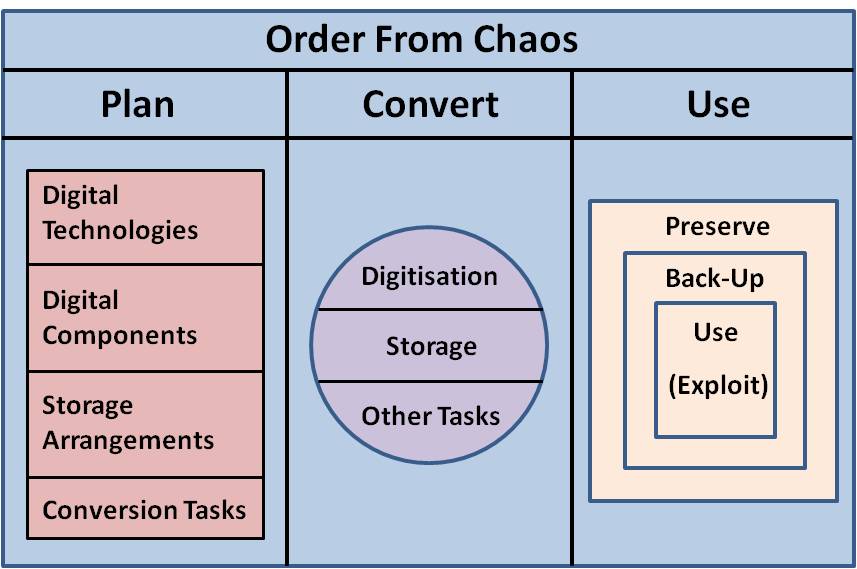
I’ve completed my quick trawl through all the entries in this blog looking for insights about Order From Chaos. Whenever I came across some relevant text I copied it into a spreadsheet and then allocated one or more categories to it. The categories were not pre-determined – they developed as I went through and I ended up with about 20 of them. I also checked the OFC White Paper which I produced in 2004. With all this as background I set out to try and produce an updated view  of what I mean by Order from Chaos in the light of my experiences over the last five years. Here’s my first attempt:

Order From Chaos (OFC), in this context, refers to the organisation of any set of things with the assistance of digital technologies. Examples of such things include: Music Collections, Loft Contents, Family Photos, Household Files, and Letters. Such material usually (but not always) starts out being in a purely physical form. Therefore, undertaking OFC usually entails some element of Planning followed by a Conversion process. The result may be purely digital or a hybrid of both physical and digital. Either way the newly organised material can be put to use in its new form, and possibly reproduced in different forms. Any new digital components will require Back-Up and Preservation procedures to be applied.

The Planning that needs to be done usually includes the identification of the digital technologies to be used; the design of necessary digital components such as file title formats and spreadsheets; a description of the storage arrangements for both physical and digital components; and an outline of the conversion process that is to be undertaken.

Conversion involves digitising the physical components, implementing the storage arrangements, and doing anything else that is necessary to ensure that the transformed set of material can be easily and effectively used.

Back-up procedures need to be put in place to ensure that both the physical and digital components are protected from loss.

Preservation procedures need to be put in place to ensure that the digital components do not become obsolete and inaccessible, and that the physical components do not deteriorate.

These  concepts are all represented in the model below. When OFC techniques are applied to a new set of things, each of the items in the model needs to be addressed.

To test the usefulness of the model I’m going to apply it retrospectively to the OFC transformations I have reported on in this blog.

Mission: Explore the Join

After 5 years and 20+ topics under the general heading of ‘OFC, Digitisation and their intersection’ it seems the right time to try and explore the join in a bit more detail. The various journeys reported in these pages provide a substantial pool of experiences, reflections and conclusions from which to derive a general understanding of what it means to organise and digitise, and of the impact on our lives of doing so. Hence my first step in this exploration will be to review all of the entries in this blog and to note relevant points. After that I hope I’ll be able to derive some general characteristics which I can then explore in further detail. Watch this space.

Disks and DMS

As part of the digital preservation work (documented elsewhere) that I’m doing on my document collection, I’ve just completed an exercise to organise and index all the associated physical disks.  It turns out that there are 156 disks of which 16 are actually contained in the collection, and the remaining 140 are backup disks (which have been accumulating over the years) of the collection’s computer system and digitised contents. Old backup disks may not be useful to restore a system crash, but I have kept them to provide an audit trail over the 20+ years that the digital system has been in operation.  Over that period documents have been lost, the index has had fields deleted by mistake, files have been corrupted, and no doubt other errors have occurred. Although the number of such occurrences is low, when such problems are identified it is very useful to have the ability to trace back through previous states of the system.

Another activity that has been prompted by the digital preservation work is to establish what future plans the current supplier of FISH (the document management system I use) has for the system. Last time I asked the question in February 2016, I was told that there are no plans to upgrade the product and that current customers who wanted to look at alternatives were being advised to consider a product called File Stream supplied by Filestream Ltd which is based in Berkshire in the UK. I spoke to the Fish supplier, m-hance, again earlier today and was told there had been no change – it is unlikely that Fish will be upgraded and Filestream is still the recommended replacement product. When I contacted Filestream last year I was told that the product would cost £750 to purchase and £250 a year for support including upgrades.

When I was investigating Filestream last year, I also took a quick look at Open Source document management systems and found several – some of them being free to use. However, further investigation would be required to establish what other components (such as the back-end database) would have to be acquired and whether they would also be free.

These and other options to future proof the collection will all be considered in the digital preservation project currently underway.

Self-Thinking

This is not so much an idea as a commentary on other great ideas…. A couple of weeks ago, my friend, Richard Harper, gave me a book to read – ‘Writing The Self’ by Peter Heehs. I guess it came up in our conversation because of my writings in pwofc.com and because of my questioning about why I keep things. However, it turns out that it informs neither of those endeavours. Instead, it made me realise, first, just how little I ever learned about mankind’s greatest thinkers; and, second, that I’m really not sure all that great thinking would have been any use to me.

The book is essentially a quick run  through of the great philosophers and theologists and their most basic tenets in respect of The Self (they may well have pronounced on other great matters but this book sticks to their ideas about Self); which, so far as I can see, tend to have concentrated on answers to the simple questions of what we are and what we are doing in the universe. The answers seem to have been anything but simple – particularly as religion seems to have provided the excuse for huge amounts of rationalisation and speculation. Thankfully, as the book points out in its last chapter, the consensus among today’s philosophers, social scientists, cultural theorists and neuroscientists is that the self is a construct not a substance; and most people in modern society take selfhood for granted, and don’t bother theorizing about it. I’m not sure where that leaves the huge amount of writings that have been produced in the past on the subject.

The ‘writings’ focus of the book seems to have four aspects; first, the fact that ideas produced by the great thinkers were recorded in writing; second, from about the 16th century onwards, the thinkers started to use their own writings for self examination (the start of the modern diary); third, memoirs and autobiographies started to become commonplace in the eighteenth century; and, fourth, also around the eighteenth century, novelists started to explore the notion of the self – sometimes using the mechanism of diaries and memoirs as a vehicle for their fictional stories. Writings in the age of the internet – the blog and social media – are only given a brief mention in the last 7 pages of the book; and, disappointingly, I found only one half page passage (on page 170 regarding the Goncourt Brothers in the nineteenth century) referring to the survival of the personality through material artefacts, writings etc. –  there must be more of that out there somewhere.

I’m left feeling that I should appreciate more, glad that at least I’m aware there is more, and thankful that I am not driven to find out more. However, It would be interesting to hear from someone who is knowledgeable in these fields as to whether the past thoughts of the great thinkers on the subject of The Self still hold any sort of sway today.

Expanding the Textbook of Text Books

I was thinking it would be good to be able to specify a particular piece of music or sound to be played when a particular piece of text was being read in a book. Then I realised that ebooks on tablets  make that feasible. In fact why stop at sound – there could be pictures or video associated with particular pieces of text. It would just be a matter of being able to specify the exact location of a piece of text on the screen when such additions start and stop or appear and disappear. Whether this would be a useful adjunct to reading is something that would have to be explored, as, no doubt, somewhere, somebody has done or is already doing – some ideas (like google glass) are just too interesting to some people to not find out they don’t work.